
Table of Content
Introduction
What is a Hernia?

A hernia occurs when one of your organs pushes through a weakness in the muscle or surrounding tissue wall.
A hernia may appear as a bulge that comes and goes with how your body is positioned, and may or may not cause discomfort or pain. Most hernias will eventually require surgical repair and in some cases, become a medical emergency.
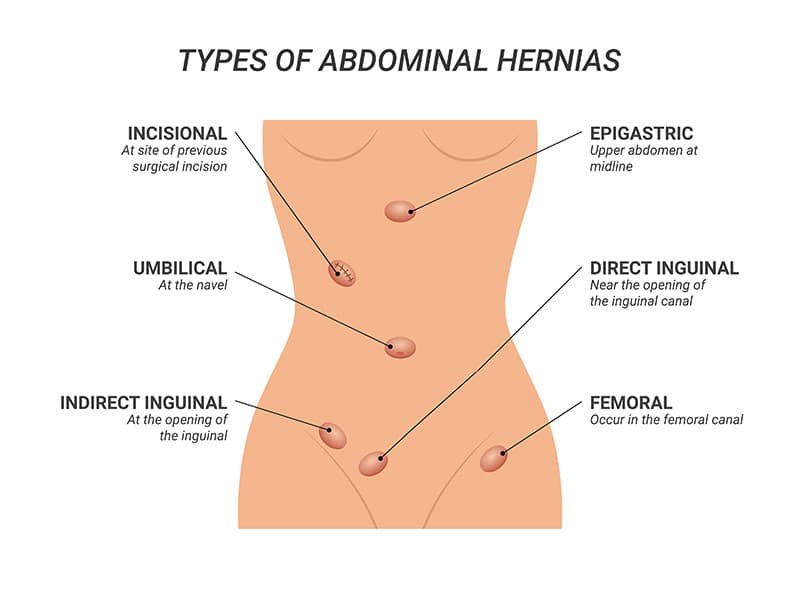
Types of Hernia
A hernia can occur within the abdominal cavity or groin area. These are some of the types of hernia:
Inguinal hernia – An inguinal hernia is the most common type, which accounts for up to 75% of cases. They appear in the groin area and are more common in men or as a congenital abnormality.
Femoral hernia – Women are more susceptible to a femoral hernia. A femoral hernia occurs when contents of your abdomen, like the intestine, pushes through the upper thigh/outer groin area.
Hiatal hernia – A hiatal hernia occurs when part of the stomach pushes through a weakness in the diaphragm and into the chest. It is one of the common causes of acid reflux and indigestion.
Incisional hernia – People who have undergone abdominal surgery may experience this type of hernia happen through a previous incision. This is due to weakened abdominal muscles, allowing organs or tissue to bulge through.
Epigastric hernia – An epigastirc hernia is a lump between your sternum (or breastbone) and belly button. It may cause severe pain and problems which may require emergency surgery.

What are the Symptoms?
- On-and-off pain or discomfort around the hernia
- Presence of bulge or lump in the affected area
- Swollen abdomen
- Nausea, vomiting, constipation

Risk Factors
- Obesity
- Pregnancy
- Weakened abdominal wall (due to age or a previous surgery)
- Heavy lifting
- Chronic coughing
- Excessive strain due to constipation
A strangulated hernia is a medical emergency. As a pre-cautionary measure, do consult a doctor if you suspect that you may have a hernia.
For emergencies after clinic hours, head to Gleneagles Urgent Care centre (UCC) and request for Dr. Tan Chun Hai.
Overview
When Hernias Become a Medical Emergency
A hernia can become a medical emergency when incarcerated or strangulated. An incarcerated hernia is when the protruding organ cannot be pushed back into place.
A strangulated hernia is a life-threatening situation when part of an organ is entraped and blood supply to the herniated organ or tissue is cut off.
How Does a Hernia Repair Work?
The idea of a hernia repair is to push the protruded organ back into place and “seal” the defect with a prosthetic mesh.
Over time, the patient’s tissue grows into the holes of the mesh device, strengthening the muscle wall.

Keyhole Surgery Expertise
A hernia repair can be carried out through open surgery or a minimally invasive way known as laparoscopic, or keyhole, surgery. Whereas an open surgery requires long incisions made in the abdomen, laparoscopic surgery only requires small incisions and is carried out with the use of specialised keyhole instruments.
Because the procedure is less invasive, keyhole surgery offers the advantage of promoting less post-operative pain, shorter hospital stay and a quicker recovery period. At Surgicare, our surgeon specialises in providing keyhole surgery when surgical repair is needed and where applicable.
20+ Years of Clinical Expertise
Dr Tan Chun Hai (陈俊海医生)
Upper Gastrointestinal, Bariatric & General Surgeon
Endoscopy & Minimally-Invasive Surgery Specialist
Dr. Tan Chun Hai is an upper gastrointestinal specialist with dual fellowship training in laparoscopic (keyhole) stomach cancer surgery and bariatric surgery.
He received dual fellowship training in minimally invasive surgery at internationally renowned gastrointestinal divisions, including Seoul National University Bundang Hospital in South Korea and Min Sheng Hospital in Taiwan.
Dr. Tan manages a wide range of digestive conditions including gallstones, gastric cancer, appendicitis and chronic GERD.
He performs endoscopies and minimally invasive surgery where appropriate, tailoring treatment to each patient’s condition and needs.
Dr. Tan is known for his calm and reassuring approach, ensuring every patient feels informed and supported throughout their treatment journey.
For suitable cases, treatment may be arranged on the same day, often within a few hours of diagnosis.
Have a concern?
Send us your enquiry or give us a call at 6250 5610
For emergencies after hours, send us a text via WhatsApp > head to Gleneagles Urgent Care Centre and request for Dr. Tan Chun Hai
Our Clinic: 6A Napier Road, Gleneagles Hospital Annexe Block, #05-36A, Singapore 258500

Frequently Asked Questions
Hernias don’t go away on their own and while small and painless hernias can be left to be observed, they may eventually require surgical repair with increasing symptoms and to prevent further complications.
There are certain factors where it may be more urgent to consider a hernia repair surgery. They include cases where the hernia has progressed and evolved in size and causing increasing symptoms such as pain, nausea, vomitting and abdominal distension.
Hernia surgery is generally a safe procedure to repair the hernia and prevent it from recurring. Only a small percentage of patients may require additional surgery, should thier hernia recur years after their first surgery. This would depend on individual patients and the type of surgery they had.
A hernia repair surgery is typically done as an outpatient procedure, allowing for patients to return home on the same day. Should patients require further monitoring after surgery, they may be required to stay in the hospital for a few days.
Surgicare Bariatric and General Surgery is on the specialist panel of most Integrated Shield and Corporate Insurance Plans.
To ensure your peace of mind, our staff will always be readily available to assist you with claims and financial estimates of your procedure(s).
Should you have any questions, please do not hesitate to contact us.